Serving Johnson City, Kingsport & Bristol, Tennessee

Home > Our Services > Routine Eye Exams
— EYE HEALTH
Routine eye exams
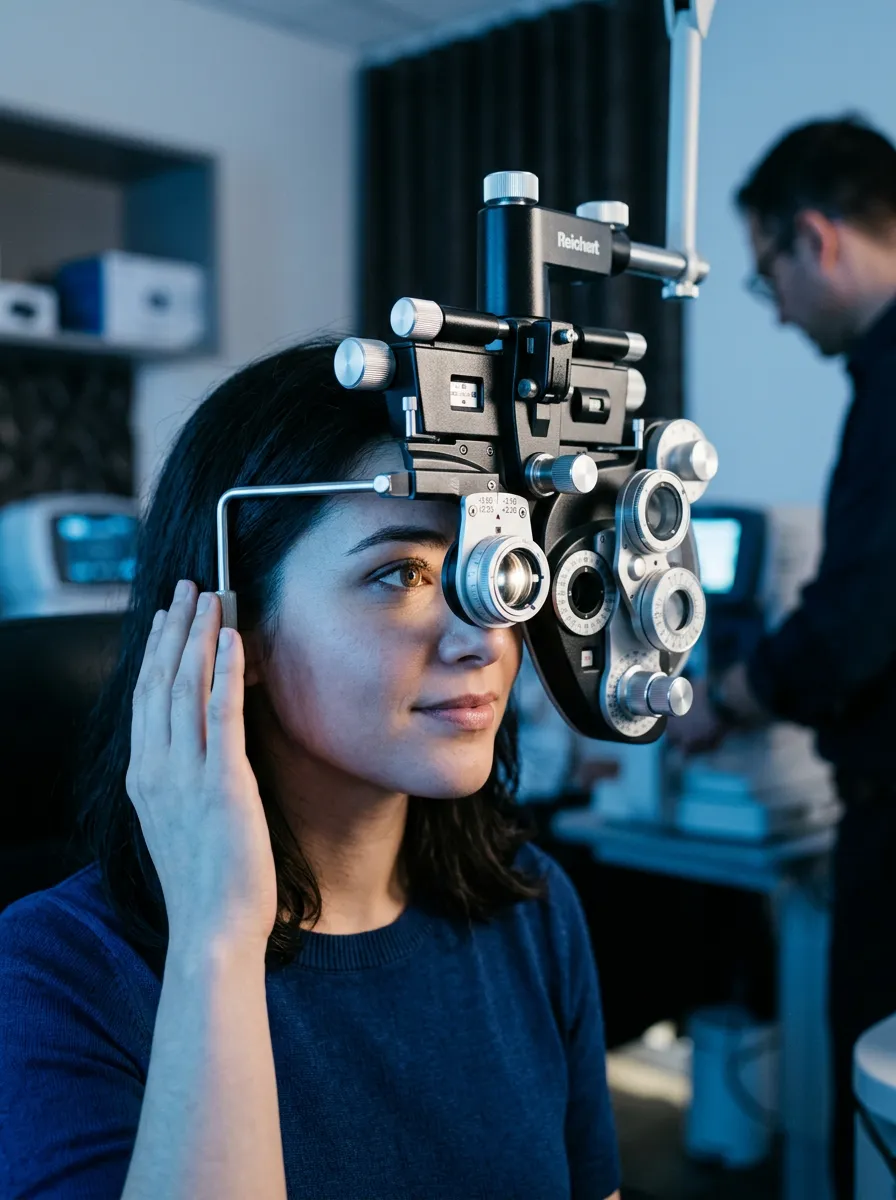
In order to maintain healthy eyes you must have routine eye exams. Regular check-ups detect issues that could later become serious and vision-threatening if not diagnosed and treated.
HEALTHY ADULTS
Every 2-3 years
GLASSES/CONTACTS WEARERS
Yearly
DIABETES OR FAMILY HISTORY
At least yearly
- HOW OFTEN
When should you
have an eye exam?
Young, healthy people without a personal or family history of eye problems should schedule routine eye exams every two or three years. As we age, we become more at risk for many common eye and medical diseases; therefore, having an annual eye exam is very important. For people who already wear glasses and contacts, a yearly exam is especially important.
People with diabetes or a family history of eye disease should have their eyes examined at least once a year. Diabetes in particular can lead to very serious eye complications. Certain professions require eye exams - pilots and military personnel, among others.
If you experience any changes in your vision between regularly scheduled visits, you should schedule an appointment at The Reeves Eye Institute as soon as possible. Early detection and treatment of problems is key to preventing loss of vision.
— YOUR EXAM
What a comprehensive eye exam includes.
We evaluate your overall eye health, screen for conditions like glaucoma and cataracts, and update your vision prescription.
01
Your medical and eye history
02
Visual acuity and an updated glasses or contact lens prescription
03
Eye pressure check to screen for glaucoma
04
Evaluation of the lens for cataracts
05
Dilated exam of the retina and optic nerve when needed
06
Time to ask questions and plan next steps
— COMMON VISION CONDITIONS
What we look for.
Have another question? Call 423.722.1311 or text 423.295.8078.
Presbyopia
Presbyopia is a condition that typically becomes noticeable for most people around age 45. In children and young adults, the lens inside the eye can easily focus on distant and near objects. With age, the lens loses its ability to focus adequately.
Although presbyopia is not completely understood, it is thought that the lens and its supporting structures lose the ability to make the lens longer during close vision effort. To compensate, affected individuals usually find that holding reading material further away makes the image clearer. Ultimately, aids such as reading glasses are typically needed by the mid-forties.
Besides glasses, presbyopia can be dealt with in a number of ways. Options include: monovision and multifocal contact lenses, monovision laser vision correction, and new presbyopia correcting implant lenses.
Myopia (nearsightedness)
Nearsighted individuals typically have problems seeing well at a distance and are forced to wear glasses or contact lenses. The nearsighted eye is usually longer than a normal eye, and its cornea may also be steeper. Therefore, when light passes through the cornea and lens, it is focused in front of the retina. This will make distant images appear blurred.
Hyperopia (farsightedness)
Farsighted individuals typically develop problems reading up close before the age of 40. The farsighted eye is usually slightly shorter than a normal eye and may have a flatter cornea. Thus, the light of distant objects focuses behind the retina unless the natural lens can compensate fully. Near objects require even greater focusing power to be seen clearly and therefore, blur more easily.
LASIK, Refractive Lens Exchange and contact lenses are a few of the options available to correct farsightedness.
Astigmatism
Asymmetric steepening of the cornea or natural lens causes light to be focused unevenly, which is the main optical problem in astigmatism. To individuals with uncorrected astigmatism, images may look blurry or shadowed. Astigmatism can accompany any form of refractive error and is very common.
Astigmatism can be corrected with glasses, contact lenses, corneal relaxing incisions, laser vision correction, and special implant lenses.
Glaucoma
Glaucoma damages the optic nerve, often with no early symptoms. Measuring eye pressure and examining the optic nerve during routine exams allows early detection. Reeves Eye Institute provides surgical and medical management, including minimally invasive glaucoma surgery (MIGS).
Cataracts
A clouding of the eye’s natural lens that develops with age. Routine exams detect cataracts early. Learn about cataract surgery.
- PATIENT STORIES
What our patients say.
★★★★★
“This is the best eye clinic I have ever been to. Everyone on the job is well trained and do great at their job. I always feel like I get the best eye exam there than anywhere.”
WANDA COPAS · GENERAL
★★★★★
“I have seen Dr Reeves since before he opened his own practice and when he opened his own practice, I followed him. I have been seeing Dr Reeves for 14 years now. He discovered a disease I had in the back of my eyes and he helped get it fixed. My eyes have been in such great care. All of his staff is very friendly, considerate, and caring. They make you feel like you are important.”
MICHELLE DECARLO · GENERAL
★★★★★
“Would HIGHLY recommend this practice to anyone that needs an Ophthalmologist. Very friendly staff. Personable, well-mannered and knowledgeable Doctor in Dr. Reeves. I was made to feel comfortable. Concerns were explained well.”
JEFF LENTCHNER · GENERAL

— YOUR EYE DOCTORS
Donny Reeves, M.D.
Dr. Scott Gentry (Johnson City) and Dr. Mohammad Mona (Kingsport) provide comprehensive eye exams, glasses and contact lens prescriptions, and disease screening and management, with Dr. Reeves providing surgical care when you need it.
— CONTINUE YOUR RESEARCH
01Diabetic Eye Care
02Dr. Scott Gentry
03Dr. Mohammad Mona
— A SIMPLE NEXT STEP
Let's make sense of what you are seeing.
Call 423.722.1311, text 423.295.8078, or request an appointment online.
Our brand promise is to provide individualized eye care services with compassion, serenity and attention to detail.
JOHNSON CITY
2328 Knob Creek Road, Suites 500 & 506
Johnson City, TN 37604
P: 423.722.1311 · F: 423.926.0529
Mon–Thu 7:30–4:30 · Fri 8–2
REEVES EYE SURGERY CENTER
2328 Knob Creek Road, Suite 500
Johnson City, TN 37604
P: 423.722.1311 · F: 423.926.0529
Surgery by scheduled appointment
KINGSPORT
444 Clinchfield Road, Suite 104
Kingsport, TN 37660
P: 423.722.1311 · F: 423.926.0529
Mon–Thu 8–4:30 · Fri 7:30–2
OUR CARE
LASIK
EVO ICL
Cataract Surgery
Retina Services
Eyelid Surgery
Routine Eye Exams
PATIENTS
Our Doctors
Financing
Testimonials
Vision Journal
Careers
Text us 423.295.8078
© 2026 Reeves Eye Institute. All rights reserved.
Privacy Policy · Accessibility · Facts About Reeves
Using a screen reader and having trouble? Call 423.722.1310.